Affiliate Disclosure: RideOnLab may earn a commission from purchases made through links in this article, at no extra cost to you. This does not affect the analysis below.
If you ride an e-bike, you’ve probably noticed the motor assistance cuts out at a certain speed and wondered what would happen if you removed that cap. It’s one of the most searched questions in e-bike communities — and also one of the most misunderstood, because the honest answer involves legal classification, insurance, and safety trade-offs that most quick answers skip over.
How we put this together: Rather than testing a modified bike ourselves, we researched how e-bike speed limiters work, reviewed manufacturer guidance, and looked at what comes up repeatedly in rider forums and safety data (including guidance referenced from the National Highway Traffic Safety Administration on e-bike injury severity at higher speeds) to understand the real trade-offs. This article is intended to help you understand the risks and legal landscape — it is not a technical tutorial, and we don’t recommend removing a safety-regulated speed limiter for public road use.
Why Speed Limiters Exist in the First Place
In the US, e-bikes are regulated under a three-class system that determines where you’re legally allowed to ride and what rules apply to you. Class 1 and Class 2 e-bikes are capped at 20 mph of motor assistance, while Class 3 e-bikes are allowed up to 28 mph. This classification is what keeps your e-bike legally defined as a bicycle rather than a moped or motor vehicle — and it’s the main reason the limiter exists on the controller in the first place.
Rules outside the US are generally stricter. The UK and EU cap e-bike motor assistance at 15.5 mph (25 km/h); anything faster is typically treated as a moped or motorcycle requiring registration, insurance, and a license. Australia’s limits vary by state but generally sit in the 15–20 mph range.
| Region | Legal Motor-Assist Limit | If You Exceed It |
|---|---|---|
| USA (Class 1 & 2) | 20 mph | May require registration; loses bike-lane access |
| USA (Class 3) | 28 mph | Reclassified as motor vehicle in most states |
| UK & EU | 15.5 mph (25 km/h) | Treated as moped/motorcycle; fines from €50–€500 reported in some jurisdictions |
| Australia | ~15–20 mph (state-dependent) | Varies by state; check local transport authority |
Laws change and enforcement varies by city and state. Always check your local Department of Transportation or equivalent authority for current rules before assuming any of the above applies to you.
What Actually Changes When the Limiter Is Removed
Based on manufacturer guidance and recurring themes in rider discussions, removing a speed limiter isn’t a simple “unlock more speed” switch — it shifts several parts of how the bike behaves at once.
Performance gains are real, but come with trade-offs. Riders consistently report a noticeable jump in top speed on flat roads. But going faster also means fighting more wind resistance, which drains the battery considerably faster than the manufacturer’s advertised range assumes — range estimates are built around the bike’s certified speed, not an unlocked one.
Components get pushed past their design range. Motors can run hotter and are more prone to overheating on sustained higher-speed riding. Brakes, tires, and frames are engineered around the bike’s certified speed class — pushing past that range reduces your safety margin, particularly stopping distance, which increases meaningfully at higher speeds.
Safety data backs up the concern. Referenced NHTSA data indicates e-bikes involved in higher-speed incidents tend to result in more severe injuries compared to standard bicycle speeds — which lines up with basic physics: a crash at 25 mph carries roughly four times the energy of one at 12 mph.
| Factor | Standard E-Bike | Limiter Removed |
|---|---|---|
| Legal classification | Bicycle | Potentially a motor vehicle/moped |
| Battery range | As advertised | Drains noticeably faster |
| Stopping distance | Within design margin | Increased |
| Warranty | Valid | Typically voided |
| Insurance | Standard coverage applies | May not cover modified bikes |
The Legal Risk Is More Serious Than Most Riders Expect
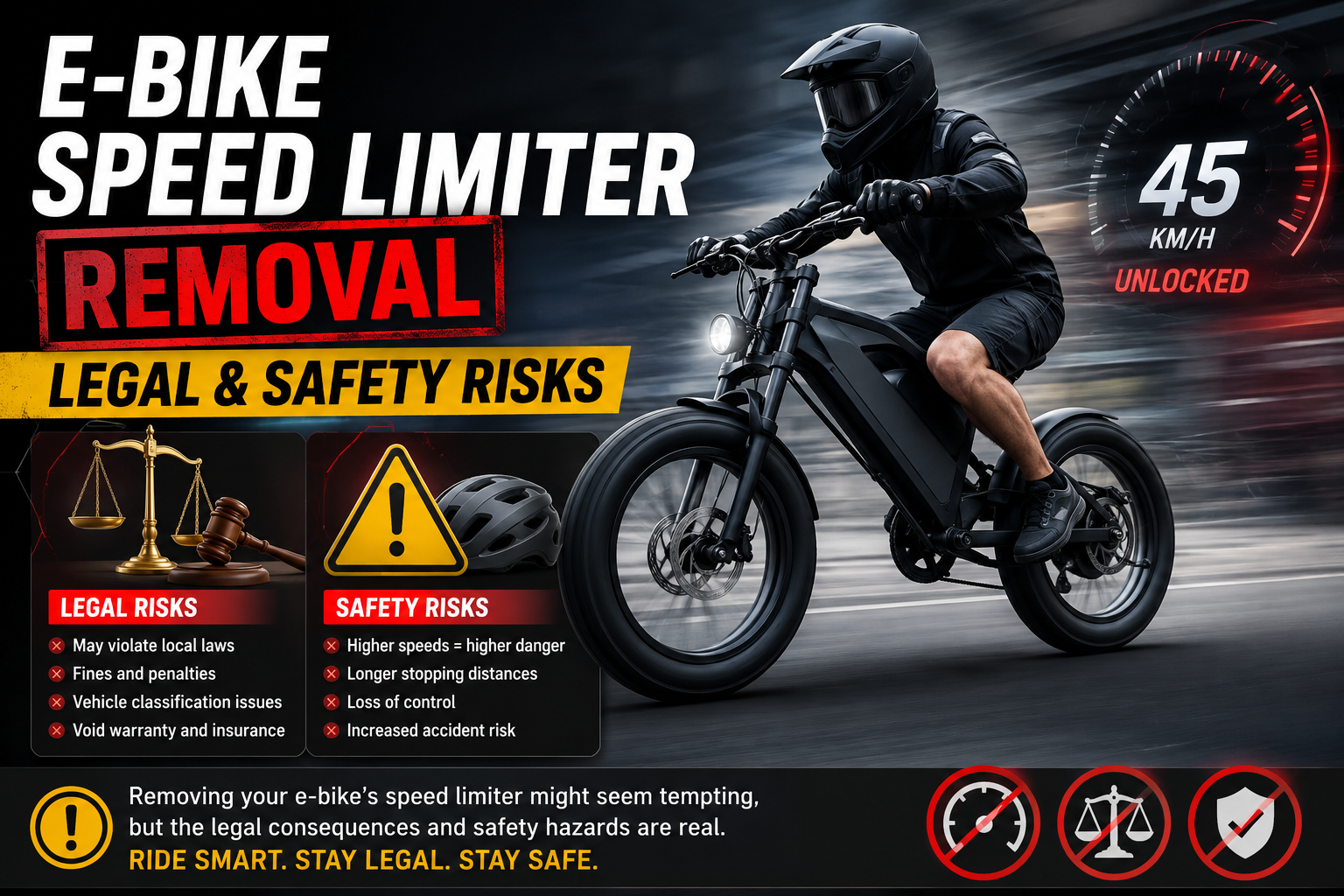
This is the part that gets glossed over in a lot of quick answers: modifying a speed limiter isn’t just a warranty issue. In several jurisdictions, tampering with a safety-regulated speed control is treated as vehicle tampering rather than a minor infraction, and enforcement includes real consequences — impoundment, fines, and in some regions the requirement to register, insure, and license the bike as a motor vehicle after the fact. If you’re only weighing “will it feel faster,” it’s worth weighing “am I still covered if something goes wrong” against it.
Is This Worth It? Depends on What You’re Actually After
Most riders considering this aren’t chasing raw speed for its own sake — they’re usually trying to solve one of a few specific frustrations. It helps to identify which one applies to you before deciding anything:
| What You Actually Want | Better Path Than Removing the Limiter |
|---|---|
| Faster daily commute | Upgrade to a Class 3 e-bike (legally rated to 28 mph) |
| More exciting/sporty rides | Off-road/private-property riding with a purpose-built performance e-bike |
| Better acceleration/hill climbing | Higher-voltage battery or more efficient motor controller (compatible upgrade) |
| Feels sluggish on flat roads | Switch to smoother, lower-resistance tires; keep tire pressure and drivetrain maintained |
How Speed Limiters Actually Work (Without the “How-To”)
It helps to understand the mechanism, even if you never touch it. Most e-bikes track speed through a sensor — often a magnet on the rear wheel — that reports wheel rotation to the motor’s controller. Once the calculated speed hits the certified limit for the bike’s class, the controller cuts or reduces electrical assistance to the motor. Some newer bikes use firmware-based limits instead, stored directly in the controller software, or expose a region/mode setting through the display that’s meant to match local regulations when you travel or import a bike.
We’re intentionally not walking through the specific wiring, magnet, or firmware steps some other sites publish, since our focus here is helping you make an informed decision — not providing a tutorial for something that carries real legal and safety consequences on public roads.
What It Actually Costs to Ride Faster Safely
If your real goal is more speed and you want to do it without the legal and safety trade-offs above, the “safer alternatives” path does come with its own costs. Here’s a realistic sense of where the money goes:
| Upgrade Path | Typical Cost Range | Legal Risk |
|---|---|---|
| Better tires + tune-up | $60–$150 | None |
| Upgraded brake set | $80–$250 | None |
| Compatible higher-voltage battery | $300–$800 | Low — confirm controller compatibility first |
| New Class 3 e-bike | $1,000–$3,000+ | None — fully legal for the speed it delivers |
| Removing the speed limiter | $0–$100 | High — fines, impoundment, voided insurance/warranty possible |
Framed this way, the “free” option is really the most expensive one if anything goes wrong — a single insurance denial after an accident, or a confiscated bike, tends to cost far more than any of the legal upgrade paths above.
If You Ride Faster (Legally), Adjust Your Maintenance Habits Too
Whether you upgrade to a Class 3 bike or simply improve components within legal limits, riding faster changes what your bike needs from you:
- Check brake pad wear more frequently — higher average speeds mean more heat and wear per ride.
- Inspect tires for wear and pressure weekly instead of monthly, since higher speeds are less forgiving of underinflated or worn tires.
- Retorque bolts periodically, especially on the stem, headset, and folding mechanism if applicable — vibration at higher speeds loosens hardware faster.
- Give the battery a full cool-down before charging after a hard ride, which is generally recommended for lithium-ion battery longevity regardless of what bike you ride.
- Upgrade to a Class 3 e-bike if higher speed is your main goal — you get the extra assist speed legally and with components engineered for it.
- Improve rolling efficiency — proper tire pressure and lower-resistance tires reduce effort and improve real-world speed without touching the controller.
- Upgrade your brakes if you want more confidence at speed — better stopping power is one of the few upgrades that improves both performance and safety at the same time.
- Keep the drivetrain clean and maintained — a well-maintained chain and gearing noticeably improves how efficiently power reaches the road.
- Work on riding technique — steady cadence, smooth acceleration, and route choice (fewer stops, smoother surfaces) often close more of the “feels slow” gap than people expect.
Common Myths Worth Clearing Up
“It’s fine as long as I only ride on private property.” This is generally true for personal liability on your own land, but it doesn’t retroactively protect you the moment you take the bike onto a public road, bike path, or trail — which is where most riders actually end up using it day to day.
“My insurance won’t know unless something happens.” That’s exactly the problem — the moment something does happen is the moment coverage gets checked, which is the worst possible time to discover a modification voided your policy.
“A faster e-bike is basically a moped, so the rules don’t matter much.” In many jurisdictions this is legally true in a way that works against you: once your bike is reclassified, moped/motor-vehicle rules (registration, insurance, license, helmet laws) apply — it doesn’t just quietly become a faster bicycle.
“The dealer/manufacturer won’t be able to tell.” Modified controllers, firmware, or sensor setups are often detectable during warranty diagnostics, and several manufacturers explicitly test for this before honoring a claim.
How to Check Your Bike’s Current Class Before Deciding Anything
Before you research any modification path, it’s worth confirming what class your bike is actually certified for — this is usually printed on a compliance sticker near the frame or motor housing, or listed in the owner’s manual and original listing. Knowing your exact class (1, 2, or 3) and your state or country’s rules for that class is the baseline everything else in this article depends on, since the legal and insurance consequences described above vary based on how far past your certified limit you’d be riding.
Bottom Line
Removing a speed limiter is technically possible on many e-bikes, and it’s a common enough question that entire forums are built around it. But the honest picture is that the performance gain is real and the trade-offs are also real: reduced legal protection, likely voided warranty and insurance coverage, faster component wear, and a meaningfully reduced safety margin at higher speeds. For most riders, the goal behind wanting more speed — a faster commute, a more exciting ride, better hill performance — has a safer and fully legal path to get there. If you’re still considering the modification after weighing all of this, at minimum confirm your local laws first, since “illegal to ride on public roads” is the single most consistent risk across every jurisdiction we looked at.
👉 Compare Class 3 E-Bikes & Upgrade Parts
FAQ
Is it legal to remove an e-bike speed limiter?
It depends entirely on your local laws and how you use the bike afterward. In most US states and across the EU/UK, exceeding your bike’s legal class speed on public roads can result in fines, impoundment, or a requirement to register the bike as a motor vehicle.
Will removing the speed limiter void my warranty?
In most cases, yes. Manufacturers typically state that modifying the controller or speed-limiting system voids coverage, meaning any resulting repairs become your responsibility.
Does removing the limiter damage the bike?
It doesn’t damage it instantly, but it does push the motor, battery, and brakes beyond the range they were engineered and tested for, which multiple sources link to faster wear, overheating risk, and reduced component lifespan over time.
What’s the safest way to get a faster e-bike?
Buying a Class 3 e-bike (legally rated up to 28 mph) gets you extra speed with components actually engineered for it, rather than pushing a Class 1/2 bike beyond its design limits.
Does insurance still cover a modified e-bike?
Often not. Several manufacturers and insurers note that modifications affecting the certified speed class can void coverage, leaving you personally liable in the event of an accident.
This article is for informational purposes only and does not constitute legal advice. E-bike laws vary by state, country, and even city — confirm current rules with your local transportation authority before making any modifications to your bike.